Samstag, 14. März | 14.45
Marechal 720 | Maia Social Housing
At CORREIA/RAGAZZI, we understand that architecture is a process of synthesis; an extraordinary process that culminates in a material asset, but where various factors – both material and immaterial – come into play as a result of the complicity and complementarity of the authors – as well as the restlessness that their culture introduces.
Marechal 720
»All invention is the mobilisation of memory. Invention is a peculiar way of organising what we know«, said Paulo Mendes da Rocha, and our response articulated this idea of the mobilisation of memory as disseminated in Porto’s literary culture by Agustina Bessa-Luís, where this writer, contrasting memory with imagination, two essential resources of creative work, draws attention to the difficulty of creating without resorting to the knowledge accumulated in memory, to which she, like us, attributes absolute prominence. She points out that without memory, »one will have to create only with the help of imagination, which is always more precarious and fragile [...] because it is born of the exaltation of thought and not of practical knowledge«.
Therefore, through this memory and the analysis of traditional housing typology – the Casa Burguesa do Porto (Porto Bourgeois House) – unusually combined with one of the most ancient archetypes – that of the Casa Pátio (Courtyard House) – the solution for this project is found. It also uses the vertical section tool to resolve the accesses and articulation of the archetypes in a complex that, delicately touching the ground at ground floor level, grows in depth on each floor, gaining area on each one, projecting itself in balance and observing the tradition of tiles in Porto to design the façades.
Maia Social Housing
In an environment of urban hostility defined by complexity of scale and fragmentation, accentuated by the proximity of a motorway access viaduct and an industrial warehouse, this proposal is based on the idea of restoring degraded urban living conditions by seeking a new balance between buildings and open space and proposing a conceptual reinterpretation of urban history, attempting to extract from it the operational tools capable of placing the proposed solutions at the level and scale of the new problems. Accepting the challenge of necessary »concentration« due to the current housing shortage, we started by reconsidering aspects of the traditional and modern city as a method for testing an alternative proposal, revisiting characteristic themes of urban tradition such as the Street, the Square, the Plaza or the Courtyard, in their capacity as archetypes through which the city was designed in the past.
The theme explored in this building highlights the importance of the street and, taking advantage of the difference in levels, proposes a vertical circulation solution that allows for the definition of entrances at different levels and equally stimulates the life of both private streets, moving away from the viaduct and the motorway, promoting a space for collective vegetable gardens and orchards.
We resorted to the courtyard in summary with the idea of Largo, since it is for collective use, which allows for housing: a place for exchange outside, but being inside (the building). In fact, the patio becomes the centre of each group of ten dwellings, well-lit and ventilated, a place for socialising and safety, for games and conversations, where children can play safely, »outside«.
It could be said that both solutions draw on tradition and the archetypes provided by architectural culture, trusting in the words of Álvaro Siza Vieira when he states that »tradition is a challenge to innovation«. Because only innovation allows us to reinvent tradition, we would add.
Graça Correia graduated in Architecture from FAUP in 1989 and collaborated with Souto Moura until 1995, later co-authoring projects such as the Portalegre Hotel and Catering School. PhD from UPC Barcelona (2006). Invited researcher at FAUP, National Habilitation in 2022, associate professor at FCATI-ULP and visiting professor at several universities. In 2005 founded CORREIA/RAGAZZI Arquitectos, whose work has been widely awarded and published, including in CASABELLA and a TC Cuadernos monograph. Author of several books, jury member of the ENOR Award and co-curator of Open House Porto 2022.
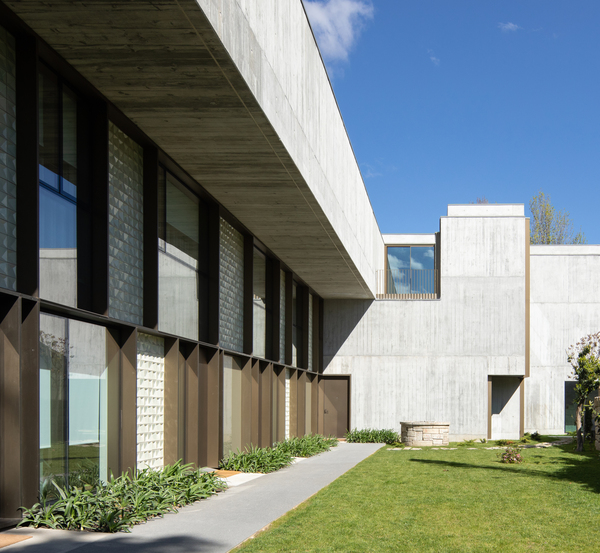
Marechal 720, Porto, Portugal 2022
Foto: José Campos