Samstag, 14. März | 16.15
Piódão Square and Tourist Office | 2 Housing Projects
Collective Housing in Alcaniça
The housing project in Alcaniça, in Almada, results from the first prize in a public competition promoted by the Instituto da Habitação e Reabilitação Urbana. Set on a residual plot within an already consolidated urban allotment, seeking to complete and reinforce the existing fabric while improving its relationship with public space. The aim was to transform a fragmented and topographically constrained site into a coherent and permeable urban ensemble.
Two independent constructions were proposed. The smaller building continues and completes the unfinished band of existing housing, while the larger, free-standing block establishes a new urban front along Rua da Bela Vista. Though placed on separate plots, both buildings are conceived as parts of a single architectural composition. Their separation generates a transversal pedestrian passage that replaces the former retaining wall and reconfigures the existing staircase, establishing a new urban link. At the southern edge, the intervention opens the site to a small public garden, turning what was once a barrier into an accessible and continuous terrain.
This gesture converts a closed and residual space into an active piece of the city. The new buildings define clear transitions between public, semi-public and private domains, mediating between street, garden and dwelling. The entrances along Rua de Alcaniça are marked by covered thresholds that protect and dignify access, reinforcing a sense of collective identity.
The design responds closely to the site’s solar orientation and slope. Each apartment spans the full depth of the building, ensuring natural cross ventilation and natural light. Living areas face south, opening to the sun and to distant views, while circulation, storage, bicycle parking and vertical accesses occupy the cooler northern side.
Environmental performance is enhanced by a bioclimatic device along the southern façade: a metallic frame equipped with adjustable textile screens that modulate solar gain throughout the year. This structure provides shade and privacy while extending the domestic space outward, forming an adaptable threshold between architecture and climate.
Through minimal yet precise operations, the project completes the urban structure, reconciles topography and movement, and redefines an overlooked plot as a porous and inhabited landscape.
Collective Housing Av. Joaquim Campos
The housing project at Avenida Joaquim Campos, in Setúbal, emerged from the public competition promoted by the Instituto da Habitação e Reabilitação Urbana (IHRU) for the construction of 183 controlled-cost dwellings. The publicly owned site occupies a vacant plot on the eastern edge of the city, within an area defined by the 1978 Integrated Plan of Setúbal (PIS). In a peripheral and weakly urban condition, the location stands at the transition between the consolidated fabric and the rural territory that opens towards the Sado Estuary. The project recognises this position not as a limit but as an opportunity to reconnect the city with its landscape.
Three linear buildings of six floors rise above a collective parking base, accompanied by commercial areas and a continuous ground plane that integrates a shared space street – a slowmobility environment where cars, cyclists and pedestrians coexist – together with a small public and commercial square and a park. These elements consolidate the north-south permeability between existing neighbourhoods and reinforce the east-west continuity of the Municipal Green Corridor, forming a new system of public spaces that mediate between built density and open landscape.
The project interprets the introduction of new density as an act of repair, stitching together fragmented residential areas while testing sustainable approaches to construction. A regular concrete structure, dimensioned for seismic performance, ensures order and permanence, while natural and biodegradable materials allow future transformation with minimal waste. This reversibility embodies an ethic of circularity and adaptability over time.
Each dwelling enjoys optimal solar orientation, cross ventilation and generous balconies that extend domestic life outdoors. The architecture acknowledges the temperate climate as a fundamental condition for living, encouraging seasonal rhythms, shade, air and the use of exterior space throughout the year.
Transforming a residual public plot into an inhabited landscape, the project proposes density not as accumulation but as a collective and sustainable form of urban renewal.
Square and Tourism Office
Piódão is located in the mountainous interior of central Portugal, on the northern slate slopes of the Serra do Açor – a territory that divides the country between Atlantic and Mediterranean climates.
Because of its altitude and exposure to the ocean, it combines the lowest temperatures and the highest rainfall in Portugal. The village is compactly settled on a steep south- and west-facing hillside, remote in space and severe in climate. Its intricate ensemble of slate houses and narrow streets descends toward the only open, level area: Cónego Manuel Fernandes Nogueira Square, the gateway and public heart of the settlement.
Over the years, this entrance was gradually taken over by cars and used as a parking lot, erasing its civic character. The project addressed the recovery of this space and the rehabilitation of the adjacent Tourist Office, altered by successive isolated interventions. The intention was to create a welcoming square – a place of arrival and encounter – through a continuous ground and the removal of visual noise to restore serenity to the ensemble.
The attitude was one of silence and precision, acting only where necessary to transform the place.
A grove of native cherry trees protects and defines the edge of the square, filtering the road and reshaping the sequence of arrival. A new continuous pavement in local hand-cut slate extends as a soft carpet up to the façades, unifying the ground and reinforcing the pedestrian character. A circle aligned with the axis of the church establishes a subtle centrality, gathering the existing statue and trees and ordering the irregular geometry of the space.
The Tourist Office was stripped of additions and simplified using durable materials, remaining open to appropriation and public use. Two light canopies shelter its entrance and that of the public restrooms, while national outdoor furniture, preserved trees and lighting complete the composition.
The project values the memory embedded in the place, sustaining the continuity of local material culture through contemporary tools. Slate becomes a vehicle of identity, anchoring the village to its landscape. Through restraint and respect, the square reveals itself – open, inhabitable and timeless, as if it had always been there.
Branco del Rio Arquitectos is an architecture studio based in Coimbra, founded in 2014 by Paula del Río and João Branco. Their work explores the relationship between architecture, territory,energy and construction, often through public commissions and housing programs. The studio has been awarded several prizes, including the FAD Award 2024 in the City and Landscape category and was a finalist for the 2024 EU Mies van der Rohe Award in the Emerging category.
Branco del Rio has won several public competitions, and their work has been widely published and exhibited.
Paula studied architecture at the ETSA Madrid between 2003 and 2010 and the Master en Proyectos Arquitectónicos Avanzados in 2011.
João studied architecture at the University of Coimbra and ETSA Barcelona between 2001 and 2008. He studied the Máster en Proyectos Arquitectónicos Avanzados, at the ETSA Madrid in 2011.
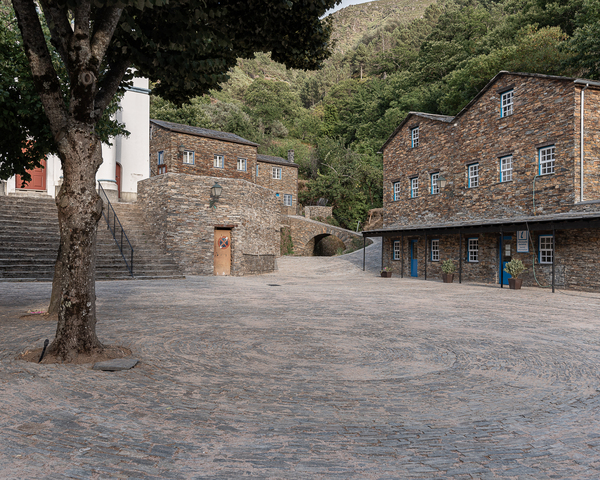
Square and Tourist Office, Píodão, Portugal 2022
Foto: Frederico Martinho